Showing posts with label Louvre. Show all posts

Tuesday, December 30, 2008

Paris' Best #1: The Louvre (introduction)

 If you only have one day to spend in Paris, spend it at the Louvre. That shouldn't come as a big shock to anyone, because the Louvre is the second most famous site in Paris, after the Eiffel Tower.

As we said after our 2006 trip to Paris, the Louvre is spectacular in most any measurement of a museum you can imagine.
It is perfectly located at the center of Paris, with the Seine River on one side and Rue de Rivoli on the other. As is our style, we did not make it over to the Louvre until noon. We suspect that getting there much earlier would provide you with a museum that is less crowded, but that would mean missing out on the Paris nightlife the night before.
 Rue de Rivoli can be seen on the left of this photo - the ground floor of the buildings on that street are a long string of trinket shops, ice cream shops, and tourist clothing stores. It did work out well that the sidewalks in front of those shops are covered (we had to walk down that street to return to the Metro) as it was lightly sprinkling when we left the Louvre that evening.
 Virtually every window out of the Louvre has a noteworthy view, as this view from the Napolean III apartments shows. The sky looks threatening in these pictures, and as the sprinkles later in the day proved, it was to some degree. And the clouds lend some visual interests to the photos anyway.

There are cafes under the Louvre pyramid where you can eat before you enter and there is at least one cafe inside the Louvre, so you won't starve if you miscalculate and need nourishment during your trip. There are almost NO water faucets in the Louvre, however, so make sure you bring or buy a bottle of water before entering. We recommend spending 4 to 6 hours at the Louvre, and you'll need at least three days to see it all. We spend one day there each trip to Paris (two so far), so we will not have been through the whole thing until we complete our next trip.

In the next post, we will begin to take a quick peek at certain areas within the Louvre. We'll only scratch the surface of the museum's contents, but it will give you a flavor of what to expect.
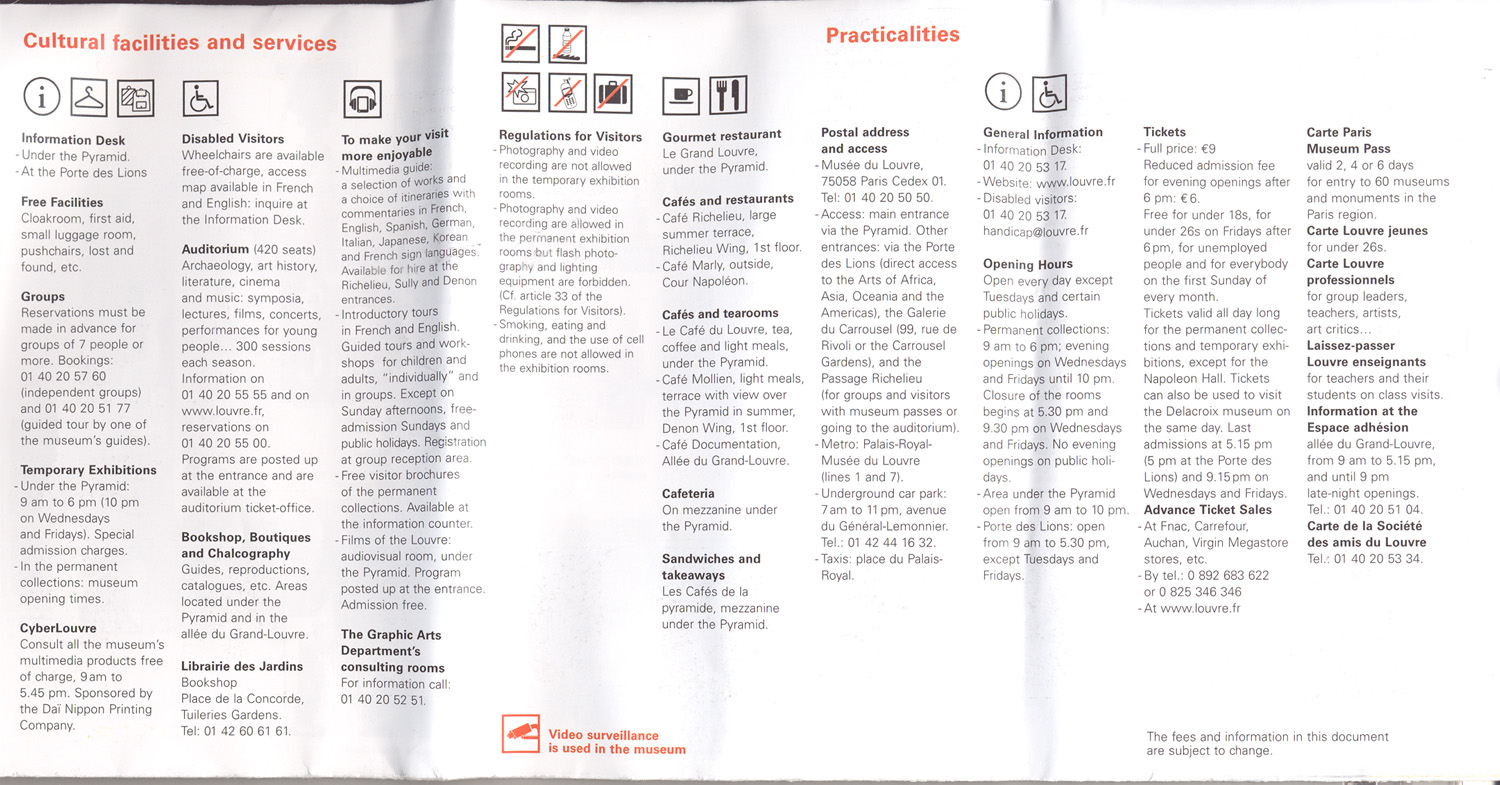
Below is a copy of the brochure they had you when you buy your ticket. It is very helpful and the museum looks very simple to navigate, but don't think you're not going to get lost a time or two! We had to stop and recalcuate our current geographic location a few times!
You may want to take a quick look at the floor plans below so you can keep track of where we are in the next few posts.


Time Required: at least three 6 hour trips
Stairs: over 100 steps
Walking: over 1 mile
What to bring: water, camera, money for lunch
Photos in this post: Olympus C-5060


Paris' Best #1: The Louvre (Denon)


 We first entered the Denon area of the Louvre. This area covers Greek, Roman, and Italian sculpture as well as French and Italian paintings. Since I am a big sculpture fan, we always make sure to give that a spot towards the top of our must-see list. Other must-sees in this area include the Mona Lisa and the Venus de Milo (aka Aphrodite). Since we entered the Louvre just after noon, the pictures you see here were mostly taken between noon and 2 PM. You'll notice that I won't focus much on the names or dates associated with the objects - there is so much to see that I tried to focus on the beauty the object possessed, then we moved on.
It is interesting that we entered some rooms that were virtually empty - as the one shown here - and others that were overwhelmed. I'm not sure how that happens, since we rarely encountered tour groups in the Louvre. In any case, the quiet rooms were much easier to photograph, though a few persons in the picture are always nice to add scale and visual interest.
 You may think that you will visit one floor at a time and complete your tour in a nice, orderly fashion. Let me bust your bubble on that one: several areas are temporarily close which will force you to use stairways to a different floor or backtrack a great deal through rooms you've already seen. Usually, we chose to switch floors and, therefore, saw things in a haphazard order.
 As was I, people seemed to particularly taken with this sculpture. It is very detailed, very well proportioned, and very unusual. Unlike painting where often a mistake can be removed or painted over, creating a sculpture is so final. Every propotion must be carefully chipped away and every chip removed is permanent.
 I must admit I've never seen an artist at work creating a sculpture, but would love to see that one day. The 3-D aspect of it fascinates me, as there are so many facets and angles that must be considered when laying out the design, and virtually every one of those angles must have a high degree of appeal. When those plans come to fruition in such an amazing way as this, I stand in awe.
 Finally, we moved on to a long narrow room that holds Italian paintings. Since there were benches along the center of this room, people tended to mill about and take a load off their feet for awhile. From our last trip, we knew that entering this room meant that the Mona Lisa was just around the next corner, to the right.
 Here is the view upon entering the Mona Lisa room. If you look verrry closely, you will see the Mona Lisa almost dead center in the photo - just above the man with the white shirt. I'm not sure why this exact setting was chosen as the surrounding paintings make the Mona Lisa look downright small in comparison. The only thing I can figure is that this room can get very crowded with people wanting to see the Mona Lisa, so the room had to be large, lending itself to larger paintings.
 There are many safeguards around the Mona Lisa. First, you can see from the bottom of this photo that the area near the painting is roped off...this photo is about as close as you can get to it without being at a severe angle. Second, there is a pane of glass in front of the Mona Lisa (something I wished they would do more often with all the crazies out there). Third, there are several discreet guards watching everything (see just to the left of Laura's head). People seem to go absolutely bonkers over this painting. We had to wait about two minutes for people to move enough for Laura to get up to the rope. The gentleman to the right (see his arm) was taking photo after photo with his pocket camera, waiting about 15 seconds before each snap. He was zoomed in so close that only the painting was in the pic (he's gonna get a better shot than the 10 million other photos of the Mona Lisa...). To the left of Laura was a woman busy text messaging all of her closest friends (probably "guess where I'm standing??") not even looking at the painting. Couldn't that be done on the other side of the room? We took 30 seconds to snap a picture and look at the Mona Lisa a few seconds, then made room for others by walking away. Sheesh.

And man does my wife look tired.  No more staying at the bars until the wee hours of the morning before we go to the Louvre.  We've done that twice now!!
 Another area in Denon had room after room of busts that I photographed. The photos turned out well, but the composition was lacking so I won't show them here. One that is worth presenting is this photo of the ceiling in one of the rooms. Once again, I sneak a little bit of Laura into the picture (I can't resist!!).
 As soon as we walked behind the Mona Lisa room, there were several rooms with French paintings and wonderfully ornate ceilings. Some of these paintings were huge - probably well over 30 or 40 feet on a side - but for some reason I only captured one painting on the camera. This beauty is no more than 5 feet tall, which is a more reasonable scale for appreciation unless you're standing 50 feet away.
 Another one of the gorgeous ceilings in this area. The height in many of these rooms started to make me dizzy, so I got adept at simply tilting the camera up, instead of my entire head. I suppose we should have taken the time to read the plaques describing these things, but everything was in French and therefore a real struggle to read.
 This is the Apollo Gallery and, since I unfortunately brought my older Olympus C-5060 camera which has problems in low light, these photos did not come anywhere near capturing the true beauty of the room...if you're interested, search out other photos on the net with google ("Apollo Gallery Louvre"). Started in 1661 and completed in 1851, this gallery was the work of over 20 artists and served as an example for the Hall of Mirrors at Versailles. This room underwent a major rennovation in 2001.
 The Apollo Gallery holds the French Crown Jewels including Louis XIV's stones. On display are the 140 carat Regent diamond, the 53 carat Sancy diamond, and the 105 carat Cote de Bretagne ruby.
 Light is carefully controlled in this room and it is typically very warm. There are many floor vents pumping in vast amounts of cool air, so I usually stand right over a vent! This room usually quite busy, as the view into it from the corridor is very inviting
 And though we always make a point of visiting our favorite lady, it always seems that we end up stumbling upon her almost by accident. The last time we saw the Venus de Milo, the room was absolutely packed - not much fun. But this time, there were only 20 to 30 people in the room so I wainted for a clearing in the view and snapped this photo. Personally, I think they could create a better backdrop for this unrivaled creation (who thought a white wall would look best behind her?), but what do I know. The woman to the rear actually added quite a bit to the composition.
 This is the room that leads to the Venus de Milo - you can see her at the very back if you look closely. Again, during our last visit there must have been 100 people in this foyer. This time, there was about 7. We always stumble upon her through a side door and leave via this foyer - that's probably why I put this photo after the close-up of the VdM.
 And finally, I wanted to show Gwen that not all rooms at the Louvre were lightly populated. Look at the mass of people in this room! I'm not sure why they all gathered here, but the chatter level was quite high. I took several photos while walking through, but nothing really noteworthy when I examined them back home.
 One area that is consistently busy is the approach to Winged Victory of Samothrace. This is because of it's location: it is at the juncture of 3 sets of stairs, in other words, it is a major intersection within the Denon area. Also called the Nike of Samothrace, this is a third century B.C. marble statue of the Greek goddess Nike (Victory). It has been displayed at the Louvre since 1884.
At it's original location in the third century B.C., it occupied a niche in an open-air amphitheater within view of the ship monument of Demetrius I Poliorcetes. Well, that's our tour of the Denon area. Again, we've only shown you a fraction of what is here, but it should give you a fair idea of what to expect. Next, we'll explore the Sully area.

Photos in this post: Olympus C-5060

Paris' Best #1: The Louvre (Sully)

 After leaving the Denon area, we entered the Sully which focuses on ceramics, terracota, Pharaonic Egypt, and Bronze objects, at least on the 1st floor where we were at the time. This first object is the Pendant with the Name of King Osorkon II: the God Osiris's Family dating from the reign of Osorkon II (874-850 BC). It is solid gold with lapis lazuli. It represents the holy triad of rht Osiris family and was a temple treasure.
 This object is labeled Coquemar, Cristal de roche, XV siecle. Monture: argent dore, France which, if I'm not mistaken, translates to "cauldron, crystal of rock, 15th century. Mounting: silver gold, France". Therefore, it is likely I actually photographed this object in the Renaissance area of the Richelieu and just mislabeled it, but I'll leave it here just in case. I'm not quite sure what "crystal of rock" means, so I may have mis-translated that part.
 This one was labeled Ange-reliquaire, France, XV siecle. Obviously from the 15th century, but I'm having some trouble translating the "Ange-reliquaire" part. I can find mention of it on French web pages, but that's not much help to me here.
 There were many fine examples of Greek and Roman pottery in this area: there must have been hundreds of objects. Whenever I see these, I wish that I could afford to have one on display in my home. Then I think about how devastated I would be if we accidently broke it, and how tempting a target it would be for thieves. I suppose I can live 99.9% as happy a life having a reproduction instead.
 This is known as the Levy oenochoe and is an Ionian "Wild Goat" oenochoe, reflecting the Oriental influence circo 640-630 BC. It is from Ionia or Rhodes, Greece and is clay with glossy pigment, engobe, and line drawings with red and white highlights. It was purchased by the Louvre in 1891.
 I was successful in finding out a little about these cheerful objects. The object on the left is a Donkey Head Rhyton found in Athens that dates from 440 BC - 430 BC and stands 9.8 inches tall. The object on the right is another Donkey Head Rhyton that dates that was also found in Athens, dates from 470 BC - 460 BC, and stands 6.7 inches tall. The note says it represents a musician and a dancer. Rhyton is a Greek word for a container from which fluids were meant to be consumed. For better photos, see the site http://www.mlahanas.de/Greeks/LX/DonkeyHeadRhytonCp3561.html
This gentleman has got me intrigued. He is the reason that I remembered to bring a camera to the Louvre this time. The last trip, I left my camera at the hotel because I did not want to carry it and, when I saw this eye popping bust, I wished I had it. This trip, I brought the camera just to take his photo. But when I got home, I had no information about this object, so I searched for over an hour on the web tonight. I finally found the object title: Tete d'Homme calcaire pente which translates to "head of man, limestone". Doh! I guess we don't know much about it. Too bad, because I think this bust's beauty approaches (but does not equal) the Nefertiti bust.
 In the Egyptian section of the Louvre, even fish become sculptures, as this school shows in a swimmingly way. Again, I could find nothing about this objects on the web but I thought it made a very neat composition anyway.
In the foreground is the gold Bowl of General Djehuty from the reign of Tuthmosis III (1479-1425 BC). It is soldered gold and engraved. Unfortunately, I can't find much information on the other objects in this photo.
It wasn't until we were about to leave that Laura mentioned how nice it would have been to take a photo of all the display plaques too, but at this point the full impact of having a camera that held 3500 pictures had not hit me yet: I was still carefully guarding each click so that we didn't get to Italy with no room left on the card. Sigh. I'd sure like to know what these things are now...can't find any information on this one.
 This one is fascinating: it is called Couple in Wood and it is wood that dates from approximately 2350 BC - 2200 BC (the old Kingdom). The Louvre website says it is 27 inches tall - I remember it being much taller (see the woman sitting behind it?) but maybe the photo is an optical illusion that has revised my memory of it's actual dimensions. It has been in the Louvre since 1826.
This is not the crispest photograph I've ever taken, but I included it because I wanted you to note their stance. Most Egyptian sculpture and painting that dates from the time of the Pharaohs have people in very stiff poses, many times with one foot forward. Unrealistic, I have thought. Remember this, because I am going to refer back to it in a few days...

Photos in this post: Olympus C-5060


Paris' Best #1: The Louvre (Richelieu)

 As will soon be evident from the number of photos I took, the Richelieu is probably my favorite area of the Louvre. This is because it contains a massive collection of French sculpture that I find extremely beautiful. And my favorite sculpture in the Louvre is Captifs by Martin van den Bogaert, aka Martin Desjardins (1637-1694).
 Apparently I am not the only one fascinated with Captifs, as it holds a prominent position for display. Here is a photo that shows you the relative scale of the piece.
 It took Martin 3 years to create this piece (1682-85). Four Captive Nations, as it is also known, represents early victories of the armies of Louis XIV over Spain, the Roman Empire, Brandenburg and Holland.
 It was originally gilt bronze and ornamented Martin's equestrian statue of Louis XIV at the Place des Victories in Paris. The equestrian statue was melted down during the Revolution, but these fantastic pieces have survived and moved to the Louvre, their gilding long since worn away. There is a marble workshop copy of the equestrian statue in the Orangerie at Versailles.
 While in most cases I would find the expressions shown to be overly dramatic, in this case they really work. The perfection of the proportions and even the weathering of the surface really make this the perfect piece to me.
 I did think to snap a photo of Captif's plaque. Here it is, so you can see what a typical artwork description looks like at the Louvre. Not easy to read if you can't read French.
 There are many extremely nice pieces of French sculpture at the Louvre, most of it in much better condition than the Greek, Roman and Egyptian sculptures. Makes sense, I guess, since the French pieces are normally hundreds if not thousands of years newer. This one is of Mercury.
 This is a bust of Georges Cuvier (1769-1832), born Georges Leopold Chretien Frederic Dagobert Cuvier, who was a major figure in science in Paris, instrumental in comparing living animals and fossils. He is known for establishing that extinction is a fact. This bust was created by Pierre-Jean David, aka David d'Angers. These Frenchmen and their aliases! You can call me Al.
 I probably snapped photos of 30 to 40% of the sculptures in this area, but will only show you a handful here. There is so much of everything that it overwhelmed me, really
 We also visited the French Sculpture section on the last trip but I liked it so much we went through it again this trip. My patient wife viewed most of it with me, then found a comfortable bench and let me get my fill of the area.
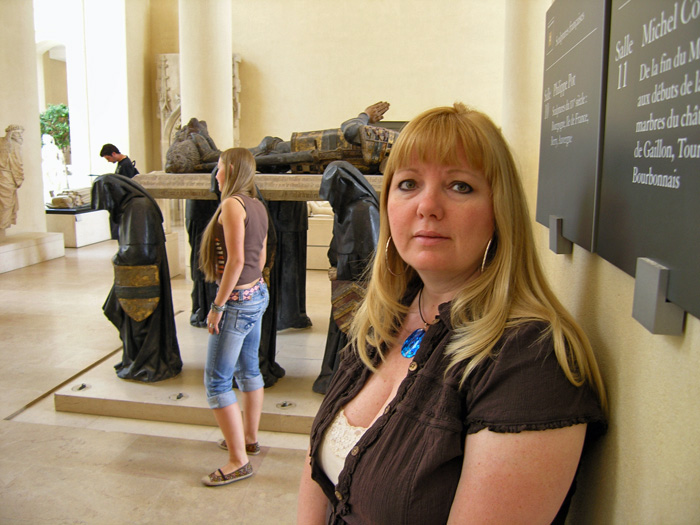
 This intriguing statue is called the Tomb of Philippe Pot. Not much is known about it except that it depicts eight nobles carrying a flagstone upon which is laid the body of Philippe Pot.
 Philippe was appointed governor of Burgundy by Louis XI. Here is another shot of it, showing the relative scale. It appears the creator of the piece wanted viewers to feel that they were participating in the procession - and it does that very successfully.
 Finally, here is an area of Richelieu that we did not visit last time: the Napoleon III Apartments. These photos do not come anywhere close to showing the full richness and beauty of these rooms - you are going to have to see it in person to get the full effect. But hopefully these photos will convince you to put this area high on your list of must-sees when you visit the Louvre.
 The crystal on this dressing table is eye-popping in person. This is another piece that is obviously a favorite, as it has been given it's own room. It is startling to walk around a corner and see this magnificent piece center stage, all alone, in a fair sized room.
 When the new Louvre was opened by Napoleon III, it had many elegant reception halls. The halls at Palais des Tuileries are long gone, but these rooms at the Ministry of State, created in 1861, have survived. The decor of gold, marble, bronze, silk and velvet are a feast for the eyes. Again, you must see it in person to get the full effect
 No flash photography was allowed in this room, so my old Olympus C-5060 could not handle it...the photo came out very poor. I borrowed this photo from elsewhere.
 This photo gives a true feel for the depth of color on the wall. However, it appears to be having a little trouble with the couches as I remember them being more red than purple. Maybe my memory is bad, I'm not sure.
 In any case, here is a smattering of other sculptures in Richelieu. If you are a sculpture nut like me, please peruse to your heart's content. If you're not, then breeze on by. Enjoy.

Photos in this post: Olympus C-5060